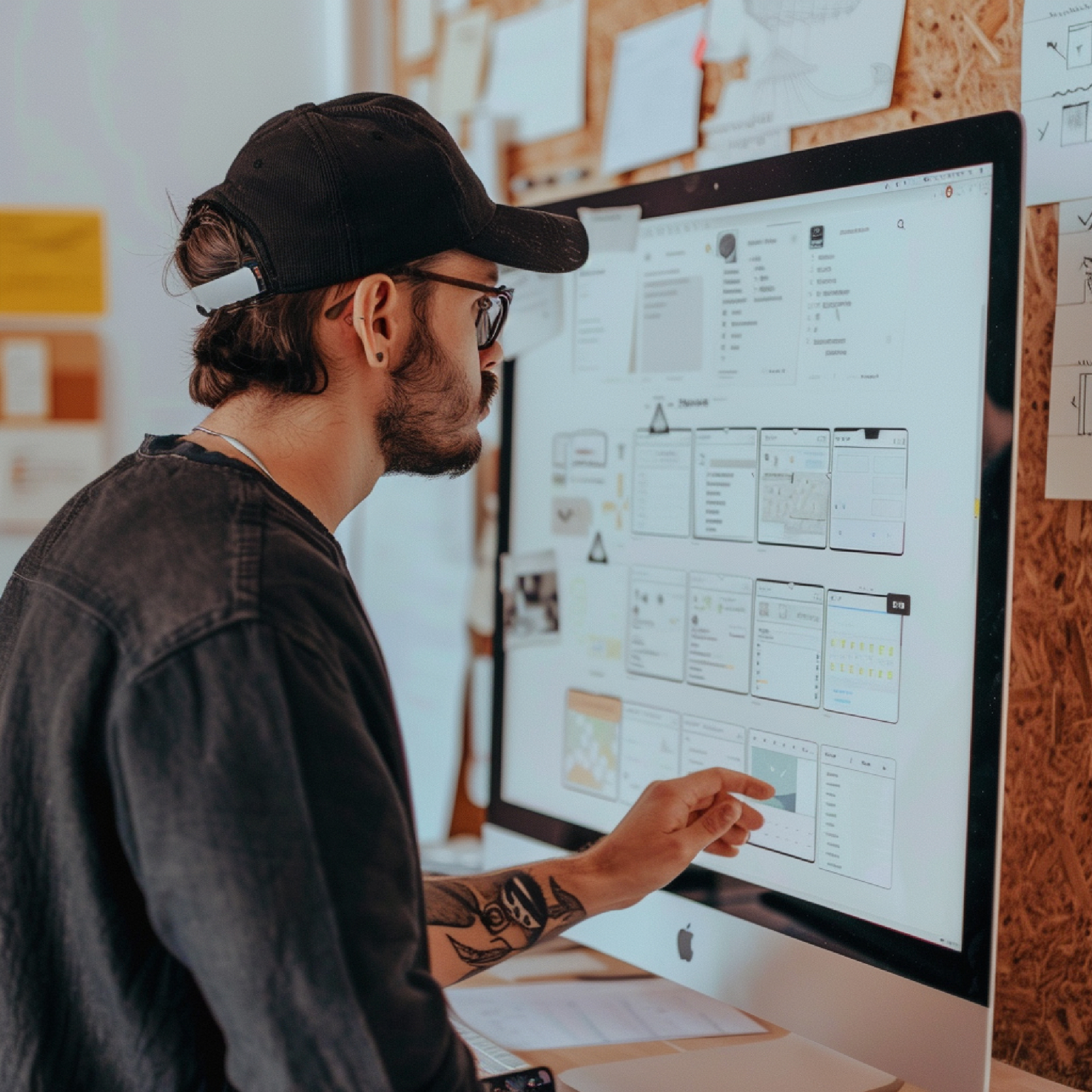
AI for UX/UI: Product Design
Master AI to lead smarter, more humane and efficient digital products
Key Data
What Is the Program About?
This program is an intensive specialization designed for Product Designers, UX/UI Designers and Product Managers to integrate AI not only to generate interfaces, but as an engine for research, information architecture and advanced prototyping.
The program addresses AI as an accelerator of the product life cycle, allowing hypotheses to be validated in record time and automating the mechanical tasks of visual design. The objective is for the student to evolve from a screen executor to an architect of AI-assisted experiences, always maintaining control over usability, data ethics and the design system.
Who Is It Addressed To?
UX/UI Designers
Who want to automate documentation tasks, information architecture and generation of visual variants.
Senior Product Designer
Who need to integrate "AI-Driven Research" processes to extract user insights in a massive and precise way.
Product Managers and Leads
Interested in understanding how AI can reduce time-to-market and improve the quality of technical deliverables.
Visual Designers
Who seek to make the leap to digital product design relying on intelligent prototyping tools.
What Type of Approach Does the Training Have?
This program has an eminently methodological, strategic and oriented approach to real production processes, moving away from technical courses based on learning loose Artificial Intelligence tools. The training addresses AI as a strategic accelerator of the digital product life cycle. The approach is designed so that the student evolves from an executor of screens to an architect of AI-assisted experiences, always maintaining control over professional judgment, usability, data ethics and the scalability of the system.
Program Objectives
AI-Driven Discovery
Use AI to synthesize user research, create proto-personas and synthetic buyers, and map complex user journeys in seconds.
Accessibility
Inclusion from the origin in our designs.
Generative UI
Learn to generate and explore high-fidelity interfaces while maintaining brand consistency.
Assisted Web Publishing
Bring high-fidelity design to a navigable, published website using an AI-assisted workflow.
Scalable Design Systems
Create and govern libraries of components, tokens and variants to ensure product consistency and scalability.
Validation and Hand-Off
Implement accessibility audit systems and prepare technical documentation for AI-driven development.
Curriculum
AI for UX Research, Creation of Synthetic Buyers
Weeks 1 - 3· 3 weeksWe lay the foundations for intelligent product design. In this block, AI becomes an advanced research analyst that allows us to process large volumes of qualitative and quantitative data to find real business opportunities.
Barrier-Free Design: Accessibility and Inclusion in the Age of AI
Weeks 4 - 6· 3 weeksWe go from analysis to solution with a fundamental conviction: accessibility is not a layer that is added at the end or a checklist, but rather the criterion that structures the solution from the first moment. In a context where AI accelerates the production of interfaces and content, this block teaches how to use it to reduce barriers - not to multiply them -, understanding the diversity of users (permanent, temporary and situational disability; cognitive diversity and neurodivergence) as the starting point of the design, not as an exception.
UI Design, Web Publishing with AI Assistant
Weeks 7 - 9· 3 weeksHigh visual intensity block. We learn how to use generative AI to create aesthetic and consistent interfaces, and take them from the screen to a navigable and published website by eliminating repetitive manual tasks.
Design System Management
Weeks 10 - 12· 3 weeksIn this last block, the student leads the system that supports a complete digital product, applying an AI-first workflow from the creation of the design system to the final delivery.
Teachers

Toni Fornes Ramis
Art direction and UX/UI designer — Program Director
Toni is a product designer, art director and lecturer. He began his training in graphic design and soon moved into digital, completing a postgraduate degree in Multimedia at IDEP and, more recently, a degree in Digital Design and Creation (UOC, 2025). He is driven by constant evolution: exploring new tools and workflows—especially the integration of AI into product design—to improve designers’ workflows. He is a partner at Agita, a digital communications cooperative where he leads the art direction and UX/UI design of projects for clients including MNAC (Museu Nacional d’Art de Catalunya), GSK and Roche. He combines professional practice with teaching, delivering courses in Figma, application design, design systems, CMS and HTML/CSS at schools including LABASAD and LCI.

Alena Nikolaeva
Senior Product Designer — Expert
Senior Product Designer with engineering training. With ten years of experience in the technology industry, he has alternated his career between product design and frontend engineering, currently performing both roles simultaneously. His work ranges from user research, UX, and high-fidelity design to actively contributing code in production. His professional impact is highlighted by his work at GitHub Copilot (Microsoft), where he has contributed to product design, engineering, and web accessibility initiatives. Specialized in the development of accessible experiences for developers through web environments, IDE and CLI, it combines the search for technical excellence with curiosity for new fields such as bioinformatics, always driven by empathy towards the user and teamwork.

Helena Feliu
Content Design & UX Writing
Co-founder of Duit Studio, Helena is a consultant specialising in Content Design and content strategy, helping companies and public administrations turn complex information into clear, useful, people-centred digital experiences. Her work brings together user research, information architecture and content design to make digital products, services and public processes easier to understand. Alongside consulting, she teaches and shares knowledge to help raise the standards of the profession. In this program, she aims to teach professionals to structure and write strategic content around one key idea: clarity is not about writing less, but about helping people understand better.

Elisabeth Martínez
Senior Product Designer · Design Systems & DesignOps
Elisabeth Martínez is a Senior Product Designer with over 10 years of experience in product design and digital experiences. Throughout her career she has worked for large companies in sectors such as fashion, banking and digital marketplaces, combining Product Design with a specialisation in Design Systems and DesignOps. Her experience focuses on the creation, evolution and scaling of design systems, as well as on defining processes, tools and governance models that improve efficiency and make collaboration between design, product and technology easier. She currently explores and applies new ways of integrating artificial intelligence into design processes and Design Systems management, with a special interest in how it can help accelerate workflows, improve documentation and bring design and development closer together without losing the designer's judgement and decision-making. She combines her professional work with teaching and outreach, taking part in training programmes, events and design communities where she shares her experience in Design Systems, DesignOps, governance and new ways of working in digital design.
Acquired Skills
Hybrid Product Designer
Ability to lead the full AI-optimized design cycle in startups and large corporations.
UX Analytics Strategist
Proficiency in the use of intelligent tools to predict user behaviors and analyze massive feedback.
UI Automation Specialist
Ability to manage scalable design systems and generate consistent interfaces without manual effort.
Smart Hand-Off Consultant
Ability to document products technically and accurately for immediate implementation by development.
Inclusive Product Designer
Ability to create accessible products (WCAG 2.2) from the source, not as a final fix.
Frequently Asked Questions
About Access and Profile
About Tools and Materials
About the Methodology and Outputs
About the Amount and Payment Methods
About Qualifications and Certification
About Access to the Virtual Campus
Contact
Write to us and we will help you find the perfect program for you.